A business selling into several countries meets WhatsApp rules a single-country business never sees. The same reminder costs a different amount in Lagos than in Nairobi, an English template needs a French version before it can go to Abidjan, and a lead from Dubai should reach the person who sells there, in their working hours.
Little of it needs a separate setup per country. One business portfolio and the same numbers can serve every market, as long as four things are planned market by market: what each message costs, which language each template goes out in, where each chat is routed, and the local rules on opt-in, regulated products and data storage.
- Cost follows the customer — Meta prices each message by the recipient’s country calling code, across 47 markets
- Templates are per language — one name, one version per language, translated by the business, not by Meta
- The country is in the ID — a phone number’s calling code, or the two-letter prefix on a business-scoped user ID, says where a customer is
- Local rules still apply — opt-in law, regulated products and data storage differ by country
How WhatsApp pricing changes from country to country
Meta does not charge one rate worldwide. Its pricing documentation sets out the rule:
Rates for messages vary based on 2 factors: a. the message category (“category”) and b. the recipient WhatsApp phone number’s country calling code (“market”).
— Meta for Developers, “Pricing on the WhatsApp Business Platform”
As of October 1, 2026, Meta’s rate card has 47 markets: 39 countries priced on their own and 8 regional groups, such as Rest of Africa. Kenya, Uganda and Tanzania all sit in Rest of Africa and share its rates, while Nigeria, South Africa, Egypt and Morocco each have their own. Morocco is one of nine markets Meta took out of a regional group on October 1, so messages to Moroccan numbers are now charged Morocco’s rate rather than the regional one.
That changes two things:
- Budget by market — a reminder campaign’s cost depends on the country codes in the customer list, so estimate it country by country from Meta’s published rate cards.
- Volume discounts are counted per country — utility and authentication rates drop in tiers as volume grows, and Meta counts each market’s volume separately, across every account in the portfolio.
Which messages are charged at all is covered in the pricing FAQ of WhatsApp Automation for Business: API Guide & Capabilities.
One template, one version per language
Templates, the pre-approved messages a business needs for contacting a customer outside the 24-hour customer service window, are where language comes in. Meta’s template documentation explains how they handle it:
Every template must have a name, but names are not unique. This flexibility allows you to create multiple templates with the same name, but in different languages.
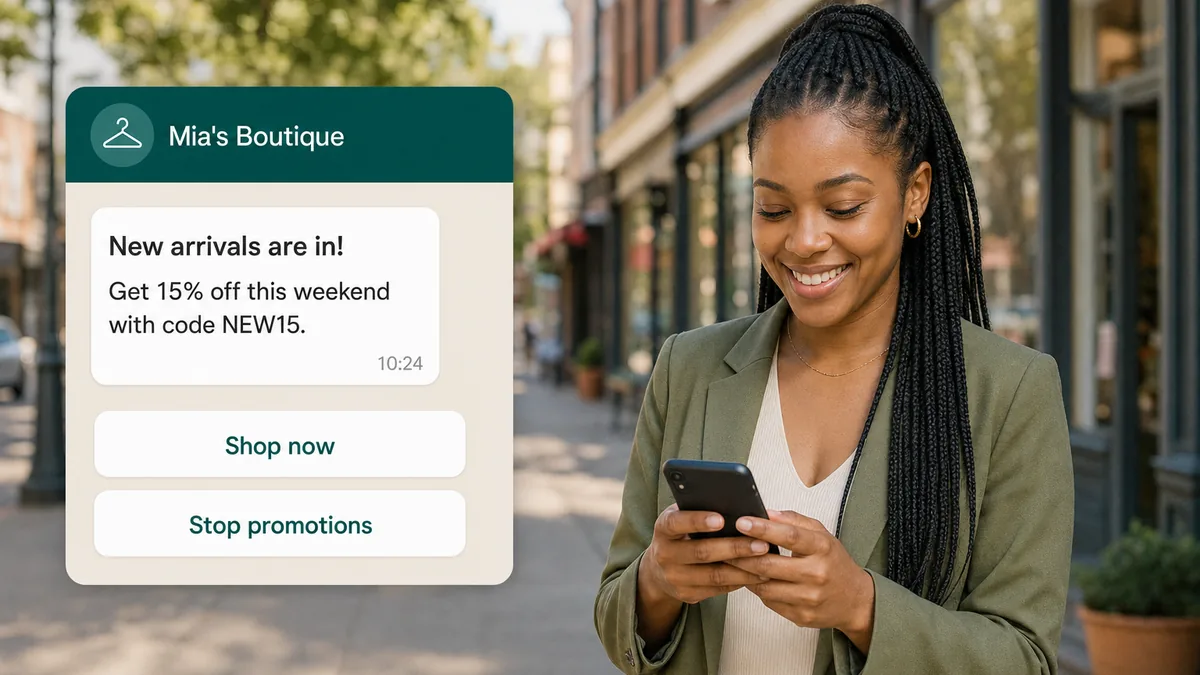
So a reminder can be one template with English, French and Swahili versions, and the automation sends whichever matches the customer. Three details catch businesses out:
- Meta doesn’t translate — the same page says “Template strings and variables are not translated by Meta”, so each version needs someone who writes the language well.
- Every version counts — each language version counts against the account’s template limit, so a reminder in five languages uses five slots.
- Record the language early — save each customer’s language from their first chat, from the language they write in or a one-tap choice, so later templates go out in it.
Routing each chat to the right country team
The country usually arrives with the message. Every incoming message reaches the business with the customer’s WhatsApp ID, which in Meta’s webhook examples is their phone number, country calling code first. A chat from a +971 number belongs with the UAE team, and one from +254 with Kenya.
WhatsApp usernames change that for some customers. Once someone turns usernames on, their phone number is left out of webhooks unless that business number has been in touch with them in the last 30 days or they are in the business’s contact book. What arrives instead is a business-scoped user ID, and the country survives in it: Meta’s documentation on business-scoped user IDs says they are are “prefixed with the user’s ISO 3166 alpha-2 two-letter country code and a period”, as in US.13491208655302741918. Routing rules should read the country from whichever identifier arrives.
From there it is ordinary routing of WhatsApp chats to the right team member, in this case that country’s team, with that market’s questions for qualifying WhatsApp leads automatically. Opening hours differ by country too, so the after-hours rule from designing escalation rules needs each country’s own hours.
Local rules that change at the border
Meta’s Business Messaging Policy applies everywhere, but it hands several decisions to local law:
- Opt-in — the policy makes the business “solely responsible for determining the method of opt-in, that you have obtained opt-in in a manner that complies with laws applicable to your communications”. An opt-in that satisfies one country’s privacy law may fall short of another’s.
- Regulated products — messaging about alcohol, over-the-counter drugs, and online gambling and gaming is allowed only “in limited countries, and pursuant to applicable law”. The policy lists the allowed countries for each and bars messaging about them anywhere else.
- Where chats are stored — Cloud API’s local storage lets a business specify where message data is stored at rest. It is set on each phone number, so a market that requires chats to stay in the country may need its own number.
Also Read: WhatsApp Business API for Multi-Branch and Multi-Location Businesses
Key Takeaways
- Meta charges each message at the rate for the recipient’s country calling code, so a multi-country campaign is budgeted market by market.
- Kenya, Uganda and Tanzania share the Rest of Africa rate; Nigeria, South Africa, Egypt and Morocco are priced individually.
- A template can have one version per language under the same name. Meta doesn’t translate them, and each version counts against the template limit.
- A customer’s country can be read from their phone number or from the prefix on their business-scoped user ID, so chats can be routed by country even when a username hides the number.
- Opt-in, regulated products and data storage follow local rules, so they are checked for each market, not once.
Frequently Asked Questions
Do I need a separate WhatsApp number for each country?
Not to message customers there. Meta prices each message by the customer’s country calling code, and its phone number documentation shows a business in India delivering correctly to a US number. A local number is worth adding where customers trust one more, or where message data has to be stored in that country, because local storage is set per number. A new business portfolio starts with two numbers, and Meta raises the cap to 20 automatically once the business is verified or reaches a messaging limit of 2,000.
Which countries can WhatsApp message data be stored in?
Meta’s phone number registration documentation lists Australia, Indonesia, India, Japan, Singapore, South Korea, Germany for the EU, Switzerland, the United Kingdom, Brazil, Bahrain, South Africa, the United Arab Emirates and Canada. Kenya and Nigeria are not on the list. Message content can still be processed outside the chosen country for up to 60 minutes on Cloud API before it is stored there, and local storage can only be switched on or changed while a number is unregistered, so decide before the number goes live.
Can I pay Meta in my local currency?
Only in one of the 16 currencies Meta has enabled: US dollars, UAE dirhams, Argentine pesos, Australian dollars, Brazilian reais, Chilean pesos, Colombian pesos, euros, British pounds, Indonesian rupiah, Indian rupees, Mexican pesos, Malaysian ringgit, Peruvian soles, Saudi riyals and Singapore dollars. The currency is picked when the Messaging account is created, and Meta’s pricing page says that “once selected, a currency cannot be changed”, though it offers Currency Migration APIs for moving to a different one.
Do one-time passcodes cost more when sent to another country?
Sometimes, and mainly for large senders. In certain markets, including India, Indonesia, Egypt and Malaysia, Meta charges an authentication-international rate when the business is based in another country. It only applies once a business is deemed eligible, by sending more than 750,000 messages outside customer service windows in a moving 30-day period to users in those markets. Most small and mid-sized businesses never reach that.
What happens if a customer’s number is saved without its country code?
Meta adds the business’s own country code to it. Its phone number documentation says: “If the plus sign is omitted, your business phone number’s country calling code is prepended to the customer’s phone number. This can result in undelivered or misdelivered messages.” A business with customers in several countries should store every number in full international format, starting with a plus sign and the country code.
Final Thoughts
The customer list is the place to start. Count customers by country code before choosing numbers or writing a single template: it shows which markets carry most of the message bill, which languages the templates need first, and whether any market is large enough, or regulated enough, to justify a number of its own.
Selling into more than one country?
ClubUnbrick sets up WhatsApp automation for businesses with customers in several markets, with pricing, languages and routing planned country by country before the first message goes out.
What We Offer
- Market-by-market cost estimates — Message costs worked out from your customer list and Meta’s rate cards.
- Multilingual templates — One template per message, with a version for each language your customers use.
- Country routing — Chats sent to the right country team, in that team’s working hours.
- Number and storage setup — Local numbers and data storage only where a market needs them.
Start with the markets you serve today; the setup takes the next one without a rebuild.