
Marketing automation in 2026 is no longer a synonym for “send an email when someone fills in a form”. The best AI marketing automation tools now plan campaigns, generate on-brand assets, score and route leads, and track where a brand shows up inside AI answer engines.
This guide covers the 10 best AI tools for marketing in 2026, grouped by the job each one does rather than ranked against each other, with every price taken from the vendor’s own published page.
- The list is organized by job, not rank: lifecycle messaging and CRM, workflow automation, content and search visibility, and social distribution
- The real 2026 shift is that platforms are rebuilding around AI answer engines. HubSpot shipped a dedicated AEO product in April; Adobe closed its acquisition of Semrush two weeks later
- Free plans that are actually usable: Brevo, Klaviyo, HubSpot, Zapier, Buffer. Gumloop and Jasper are trial-only
- Most teams win fastest by pairing one system of record with one workflow tool and one content layer, which is three tools, not ten
- Start with the bottleneck you can name out loud, then add the next tool only when the first one is fully used
Why AI Marketing Automation Tools Matter in 2026
Marketing spent 2026 reorganizing itself around a single problem: buyers increasingly get their answer from an AI assistant instead of a results page, and the marketing stack had no way to see that traffic. Two announcements two weeks apart show how seriously the platform vendors took it.
On 14 April 2026, HubSpot launched HubSpot AEO, which it describes as “a new solution for answer engine optimization that helps marketers tap into that opportunity by understanding, tracking, and optimizing how their business appears in answer engines like ChatGPT, Gemini and Perplexity.” It sells for $50 per month standalone, and is bundled into Marketing Hub Professional and Enterprise.
Then, on 28 April, Adobe “announced the completion of its acquisition of Semrush Holdings, Inc.”, a company Adobe describes not as an SEO suite but as “a leading brand visibility platform.” Jasper spent the same period repositioning from a copywriting tool into an enterprise content platform built around AI-search visibility.
That is the useful signal for anyone choosing tools this year. Three of the ten below changed what they sell this year, and the reason is the same in all three cases. For the background on why, AI Overviews changed how search results get read before any of these products existed.
What Is the Difference Between Agentic AI and Traditional Automation?
Traditional marketing automation executes rules you wrote in advance. Agentic AI proposes the flow, drafts the variants, and adapts based on performance signals without waiting for you to specify each branch. Governance stays yours: brand, compliance and data quality do not become the tool’s problem just because the tool got faster. What changes is that you spend your time reviewing decisions instead of building them.
Agentic AI, still at its frontier, has the potential to reconfigure the entire marketing workflow.
— Boston Consulting Group, “The Agentic Marketing Race Is On,” November 2025
How We Chose These AI Marketing Automation Tools
Every pick below clears all four of these bars, not just one:
- Real automation depth — journeys, segmentation, triggers or orchestration you can build without an engineer
- AI that changes the output — generation, prediction or optimization, rather than a subject-line suggester bolted onto a 2019 product
- A job a marketing team can name — lifecycle email, CRM, workflow, content, search visibility or social
- Published pricing, or honest silence — a public price page, or a clear statement that the product is enterprise-only
These ten picks are not one category. Some are traditional rule-based automation, some are agentic AI that plans and adapts on its own without a person specifying every branch, and several are a blend of both in one product. That split is not settled: agentic AI is still early, and where each tool sits on that spectrum will keep shifting as the category matures.
The 10 Best AI Marketing Automation Tools in 2026
These are numbered for reference, not ranked. They run in job order: five lifecycle and CRM platforms, two workflow tools, two content and search tools, and one for social. Take one from each group where you have a real bottleneck, and none from the groups where you do not.
1. HubSpot — Best All-in-One CRM and Lead Nurturing
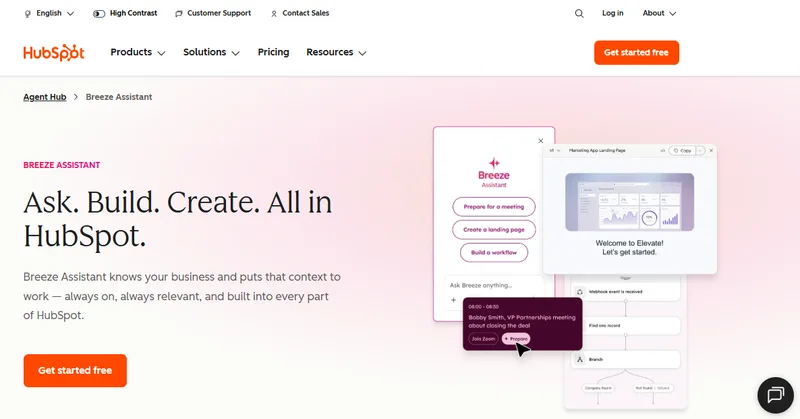
If you want one platform holding contacts, lifecycle stages, segmentation, nurture email and reporting, HubSpot is still the strongest option in B2B. The AI layer, branded Breeze, now runs as a set of agents rather than a set of buttons, and the April 2026 release added HubSpot AEO for tracking how the brand surfaces inside ChatGPT, Gemini and Perplexity. The visual workflow builder is the reason teams stay, because sales and marketing read from the same record.
What to automate: Lead nurturing, MQL to SQL routing, lifecycle reporting, pipeline-based personalization, onboarding drips, post-purchase flows
Best for: B2B growth teams that want one source of truth across marketing, sales and service
Pricing: Free tier for up to 2 users. Paid plans are now priced per seat across the whole platform rather than hub by hub. Starter lists at $20 per seat per month and is discounted for new customers, for a limited time, to $7 on annual billing. Professional is $90 per seat per month on annual billing, or $100 month-to-month. Enterprise is $175 per seat per month
Watch out for: Professional and Enterprise both require a one-time onboarding purchase, and HubSpot no longer prints its price on the pricing page, so get the quote before you budget. Each paid plan also comes with a monthly allowance of HubSpot Credits (5,000 on Starter, 10,000 on Professional, 15,000 on Enterprise), and credits beyond it cost $0.010 each
2. ActiveCampaign — Best Predictive Email Automation on a Small Budget
ActiveCampaign is a lifecycle platform with a CRM attached, and its Active Intelligence layer is unusually complete for the price. Its own pricing page lists predictive sending, AI-suggested segments and an AI campaign builder as plan features rather than paid add-ons, though lead scoring and win probability now sit in its paid CRM add-ons. For teams whose main channel is email and whose main constraint is budget, it does more per dollar than anything else here.
What to automate: Email sequences, behavioral segmentation, send-time optimization, and lead scoring or win probability once the CRM add-ons are in place
Best for: Small and mid-sized businesses that live in email and want prediction without an enterprise contract
Pricing: Starter from $15 per month for 1,000 contacts, billed annually. Plus ($49), Pro ($79) and Enterprise ($145) sit above it on the same billing. No free plan; there is a 14-day free trial
3. Brevo — Best Low-Cost Lifecycle Email and Transactional Sending
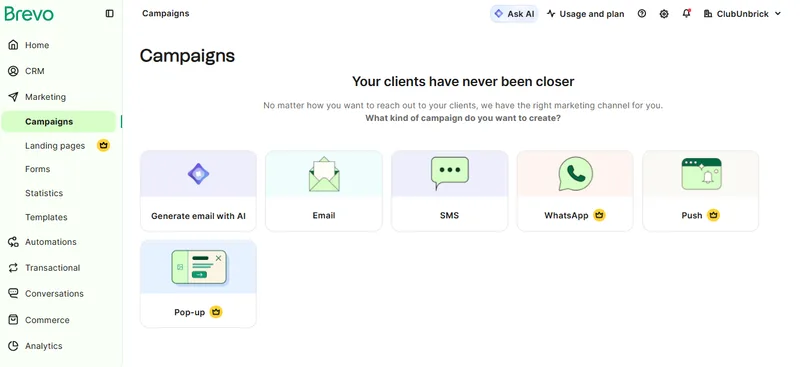
If the priority is AI email marketing automation without a platform migration, Brevo does the basics properly at a price that does not scale against you. Welcome series, nurture, cart recovery and re-engagement all work out of the box, and the transactional sending is genuinely good, which matters more than most comparison tables admit.
What to automate: Onboarding drips, post-purchase flows, lead scoring, cart and browse abandonment, transactional sends
Best for: Small and mid-sized business lifecycle email plus light cross-channel messaging
Pricing: Free plan capped at 300 emails per day. Starter from $9 per month and Standard from $18 per month, both scaling with send volume. Professional starts at $499 per month, and Enterprise is custom
What Brevo Looks Like in Production
This is the one tool on the list we can speak about from the inside rather than from a feature page. Every form on clubunbrick.co runs through Brevo. We use it to automate email capture into custom lists and trigger automatic replies, handle lead scoring based on priority and message content, and run transactional emails and newsletters that stay on brand without reading generic or obviously AI-written. It is a solid place to start if you are getting into AI automation and unsure about handing a part of your marketing to it.
4. Klaviyo — Best for Ecommerce Email and SMS
Klaviyo is the default for direct-to-consumer brands for a reason that has nothing to do with its email editor. It is built on the store’s order and browse data rather than on a contact list, so predicted lifetime value and churn risk are properties of the customer record instead of a report you run once a quarter. The 2026 lineup adds Composer, which audits and builds flows and campaigns from a prompt, and a Customer Agent that handles support and selling against your own data.
What to automate: Cart and browse abandonment, post-purchase and replenishment flows, win-back campaigns, SMS running alongside email in one journey, predictive lifetime value segmentation
Best for: Ecommerce and direct-to-consumer brands on Shopify, WooCommerce or BigCommerce
Pricing: Free plan covering up to 250 active profiles, 500 email sends per month, $5 of mobile messages and $5 of Composer usage per month. Paid email starts at $20 per month for 500 active profiles and 5,000 emails, and scales on active profiles, not on sends
Watch out for: Billing counts every contactable profile, including the ones you never email. Prune the list or pay for it
5. Braze — Best for Real-Time Omnichannel at Scale
Braze is built for consumer brands and apps that need journeys firing across email, push, in-app and SMS in real time, with experimentation as a first-class feature rather than an afterthought. It is the one enterprise-priced tool that survived this year’s cut, because nothing cheaper does cross-channel orchestration at volume as well.
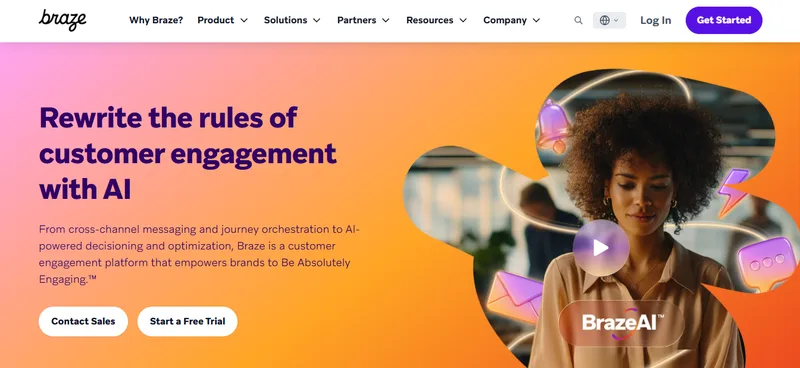
What to automate: Cart and browse abandonment, post-purchase flows, churn prevention, cross-channel experiments, real-time triggered messaging
Best for: Consumer brands and apps with high message volume and real-time triggers
Pricing: Enterprise, quoted on request. There is no self-serve tier
6. Zapier — Best Integration Layer for Marketing Ops
If you have ever said “I just need these two apps to talk”, Zapier is still the fastest answer. It is not a marketing platform and does not try to be. It is the connective tissue that turns a pile of subscriptions into a system: capture a lead, enrich it, route it, notify someone, trigger the follow-up.
What to automate: Lead routing, UTM capture, enrichment, alerting, nurture triggers, form-to-CRM handoffs
Best for: Automating handoffs across forms, CRMs, email tools, Slack and spreadsheets
Pricing: Free plan with 100 tasks per month. Professional from $19.99 per month billed annually for 750 tasks, or $29.99 month-to-month. Team from $69 per month billed annually
The alternative worth pricing: Make.com covers the same ground on a visual canvas and has moved harder on AI, shipping Make AI Agents (still in beta) and Maia, a builder that works through natural conversation, on every tier including the free one. Its Core plan is $9 per month for 10,000 credits on annual billing, against Zapier’s $19.99 for 750 tasks on the same terms. Zapier still wins on app coverage and on how fast a non-technical marketer gets a first workflow live; Make.com wins on price per operation and on branching logic. Teams with a developer sometimes skip both for the self-hosted route, which is where n8n comes in
7. Gumloop — Best for AI-Native Agentic Workflows
Gumloop belongs to a newer category than Zapier: workflows that carry multi-step reasoning rather than fixed branches. It connects more than 35 models, including OpenAI’s, Anthropic’s, Google’s and xAI’s, to your internal tools without code, which makes it the right choice when the task is genuinely judgement-shaped, such as reading fifty inbound briefs and sorting them. It raised a $50 million Series B led by Benchmark in March 2026.
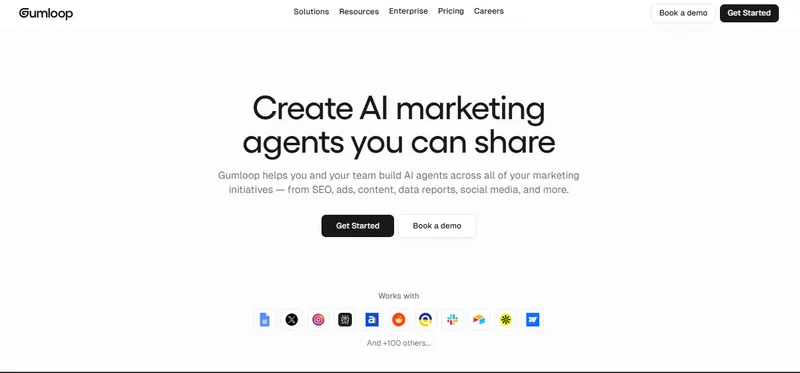
What to automate: Content brief generation, internal reporting, QA checks, lead enrichment, and research-to-publish chains that would otherwise be a person reading things
Best for: Small and mid-sized teams automating work that needs a judgement call at each step, without hiring developers
Pricing: Pro from $37 per month for 20,000 credits, with a 14-day trial and no permanent free tier. Enterprise is custom
Watch out for: Pro adds an 8% orchestration fee. Bringing your own model API key drops the token cost to zero but doubles that fee to 16%, charged on what the task would have cost without your key
The company claims that it now allows teams at organizations like Shopify, Ramp, Gusto, Samsara, Instacart, and Opendoor to deploy reliable AI agents that autonomously handle complex, multistep tasks, all without ever needing an engineer.
8. Jasper — Best for Brand Voice Governance
Jasper is no longer competing on writing quality, because it cannot: a general-purpose model drafts a landing page about as well as it does. What it sells now is consistency at headcount, which is a different product. Its Brand Voice feature learns tone, style and terminology and then enforces them across everything the team generates, and the 2025 and 2026 releases added an MCP server and a spreadsheet-style pipeline interface for running content production at volume.
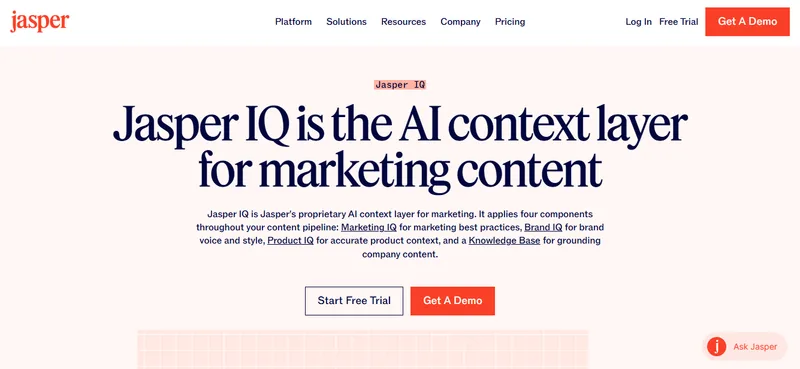
What to automate: Ad variations, email drafts, landing page sections, repurposing chains, blog drafts and social captions, all held to one brand standard
Best for: Marketing teams with enough content creators that drift is a real cost, and agencies running several client brands in parallel
Pricing: Pro at $59 per seat per month billed annually, or $69 month-to-month. Business is custom-priced and adds Jasper Grid, custom agents and API access. There is a 7-day trial
Capture the heart of how your brand sounds across every channel. Jasper adapts tone and messaging so you can stay consistent at scale.
9. Semrush — Best for SEO and AI Search Visibility
Semrush became an Adobe company on 28 April 2026, and the product now reflects what Adobe paid for. Its price list is now titled “SEO + AI Search”, and even the entry plan puts AI visibility reports and custom prompt monitoring next to position tracking. The AI writing tool formerly sold as ContentShake AI has been folded into the Content Toolkit.
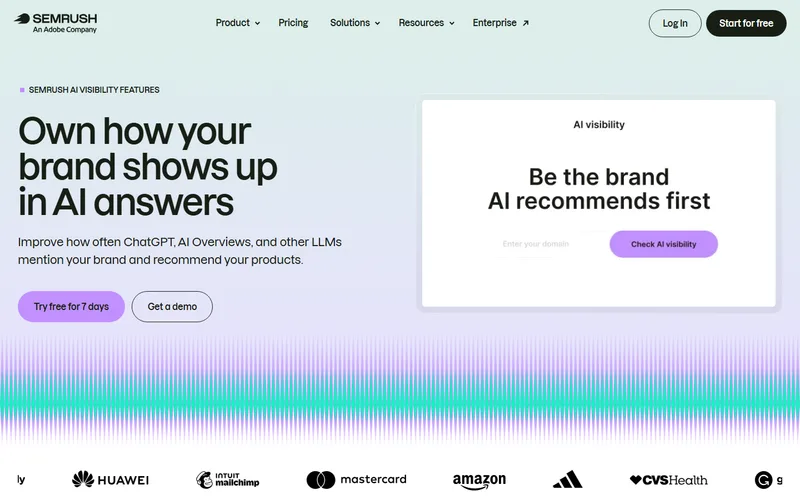
What to automate: Topic discovery, keyword clustering, SEO-first outlines and drafts, competitor content analysis, and prompt-level tracking of where the brand appears in AI answers
Best for: SEO teams and content marketers who need organic and AI-answer visibility on the same screen
Pricing: The SEO plan is $117.33 per month billed annually, or $139 month-to-month, with Starter, Pro+ and Advanced above it. Starter tracks 50 prompts a day and Pro+ tracks 100
Worth being clear about the limit. The data tells you what to write about. Whether the resulting draft is publishable is still a judgement a person has to make. Headings, internal links, meta descriptions and image alt text stay a manual checklist unless you build one, and the on-page fundamentals every post has to hit did not change because a model wrote the first version.
10. Buffer — Best for Social Scheduling
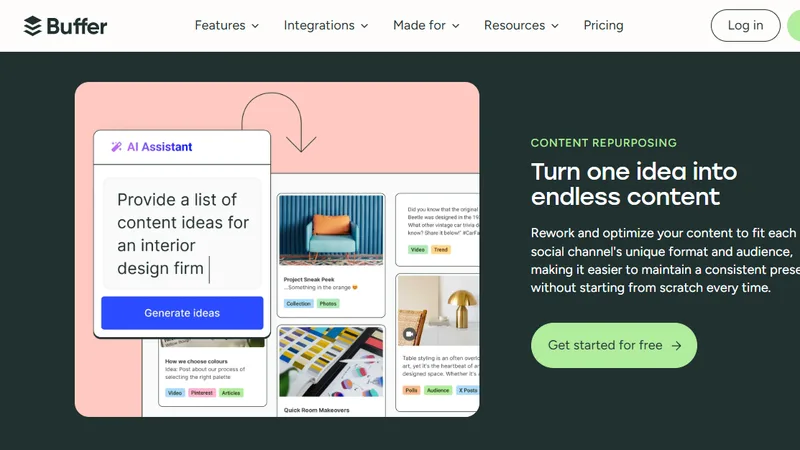
Buffer is the least ambitious tool on this list, and that is the point. It schedules posts across channels, keeps a queue predictable and reports on what happened, with an AI assistant for captions and repurposing available on every plan including the free one. Hootsuite and Sprout Social do more, and start at $99 and $199 per user per month respectively on annual billing. For a small team, Buffer’s per-channel pricing is the difference between publishing consistently and not publishing at all.
What to automate: Weekly queues, evergreen recycling, multi-channel publishing, caption variations
Best for: Solo marketers, small teams and agencies that need consistent scheduling and light analytics
Pricing: Free for 3 channels at 10 scheduled posts each. Essentials at $6 per channel per month, or about $5 on annual billing. Team at $12 per channel per month, or $10 on annual billing. Every channel past the tenth costs less than the standard rate
Also Read: How to Repurpose Long-Form Video Into Short-Form Content
Pricing Snapshot
| Tool | Job | Entry price |
|---|---|---|
| Brevo | Lifecycle email | Free (300 emails/day); Starter $9/mo |
| ActiveCampaign | Predictive email + CRM | $15/mo billed annually, 1,000 contacts |
| Klaviyo | Ecommerce email + SMS | Free (250 profiles); paid from $20/mo |
| HubSpot | All-in-one CRM | Free (2 users); Starter $20/seat/mo, $7 on promo |
| Braze | Real-time omnichannel | Enterprise, quoted on request |
| Zapier | Integration layer | Free (100 tasks/mo); Pro $19.99/mo annual |
| Gumloop | Agentic workflows | $37/mo for 20,000 credits (14-day trial) |
| Jasper | Brand voice content | $59/seat/mo annual ($69 monthly) |
| Semrush | SEO + AI visibility | $117.33/mo annual ($139 monthly) |
| Buffer | Social scheduling | Free (3 channels); $6/channel/mo |
Prices as of October 2026.
How Do You Choose the Right AI Marketing Stack?
Nobody needs ten tools. You need one from each group where you have a bottleneck you can describe in a sentence, and the right combination changes with your stage and your data.
If You Are a Solo Marketer or Small Team
Take Brevo for lifecycle email, Buffer for social, and Zapier for the handoffs between them. That is roughly $47 a month at three channels, and all three have free plans you can prove the workflow on before paying for anything. Swap Brevo for Klaviyo if you sell products online, because order data is worth more to you than a lower monthly price.
If You Are an Agency Managing Multiple Clients
Take Jasper for brand voice, because drift across client accounts is the failure mode that costs retainers, HubSpot for the CRM and reporting layer, and Gumloop for the per-client workflows that never look the same twice. Price Make against Zapier before committing to either, since agencies run high operation counts and the per-operation gap compounds fast.
If You Are an Enterprise or Consumer Brand
Take Braze for orchestration and Semrush for search and AI visibility. Add Salesforce Marketing Cloud if you already live in Salesforce, or Adobe Marketo Engage if demand generation is B2B and long-cycle. At this scale a dedicated paid-media layer such as Albert by Zoomd starts to make sense, which it does not below it.
Also Read: Automating Website Content with WordPress MCP Integration
What Breaks Marketing Automation, Even with the Best AI?
AI does not fix messy foundations, it executes them faster. The failure points are almost always the same three, and none of them is the tool.
- Data quality — duplicate contacts, broken attribution, event tracking that fires inconsistently
- Integration gaps — CRM, email and website analytics that disagree about who a person is
- Governance — no brand rules, no QA step, no experiment process, so nobody can tell whether a change helped
AI won’t stay on brand unless you teach it how.
What Should You Measure to Prove Marketing Automation ROI?
An automation program that cannot show revenue does not survive its second budget review. Four metrics carry most of that argument:
- Revenue per recipient — by segment, across email, SMS and push
- Conversion rate by journey step — which tells you where people leave, not just that they did
- Time-to-launch — the cleanest read on whether the AI is buying you anything
- Incremental lift against a holdout — the only one that proves the program caused the revenue
Key Takeaways
- Pick by job, not by hype: lifecycle and CRM, workflow, content and search visibility, social. Buy one per bottleneck
- The fastest start is one system of record plus one workflow tool plus one content layer, which is three subscriptions and not ten
- Brevo, Klaviyo, HubSpot, Zapier and Buffer have real free plans, so a first stack can be proven before it is paid for
- Zapier and Gumloop solve different problems: fixed handoffs versus workflows that need a judgement call at each step
- Jasper earns its seat price for brand governance across a team and is hard to justify for one writer
Frequently Asked Questions
Which of these tools have a genuinely free plan, not just a free trial?
Five of them, and the limits are worth knowing before you commit. Brevo’s free tier caps sending at 300 emails per day. Klaviyo’s free plan covers “Up to 250 active profiles”, “500 email sends/month”, “$5 of mobile messages/month” and “$5 of Composer usage/month”. HubSpot’s free tier covers up to two users with no credit card. Zapier’s free plan includes 100 tasks per month. Buffer’s free plan covers three channels at “10 scheduled posts per channel”. Gumloop and Jasper are trial-only, at 14 days and 7 days respectively, and Braze and Semrush are paid from the start.
How much does a working AI marketing stack actually cost a small business?
Under $50 a month at list price, if you buy narrowly. Brevo Starter is $9 per month, Zapier’s Professional plan starts at $19.99 per month billed annually for 750 tasks, and Buffer Essentials is $6 per channel per month. Three social channels puts that combination at roughly $47. The number changes shape entirely if you move to HubSpot Professional, which is $90 per seat per month on annual billing, so $270 a month for a three-person team. HubSpot also states that “Professional or Enterprise plans are required to purchase onboarding”, and quotes that fee separately rather than printing it on the pricing page. That onboarding fee is the line most first budgets miss, because it does not appear in the monthly figure anyone quotes.
Can automated email get my sending domain blocked?
Yes, and Google publishes the thresholds you have to stay inside. Every sender is told to “Keep spam rates reported in Postmaster Tools below 0.30%”, and the same page’s guidelines set a tighter target: “below 0.10% and avoid ever reaching a spam rate of 0.30% or higher”. Anyone sending more than 5,000 messages a day to Gmail accounts must also “Set up SPF and DKIM email authentication for your domain” and “Set up DMARC email authentication for your sending domain”. For those senders, “Marketing messages and subscribed messages must support one-click unsubscribe, and include a clearly visible unsubscribe link in the message body”. Automation makes these easier to breach, because a badly targeted trigger reaches people who never asked to hear from you. Set the authentication up before the first campaign rather than after the complaints.
Does Google penalize content written by an AI tool?
Not for being written by AI. Google’s guidance draws the line at intent rather than authorship: “If you use automation, including AI-generation, to produce content for the primary purpose of manipulating search rankings, that’s a violation of our spam policies.” The same page suggests disclosure where a reader would reasonably wonder, noting that “AI or automation disclosures are useful for content where someone might think ‘How was this created?’”. A Jasper or Semrush draft that a person then fact-checks, sources and edits is not what the policy targets. Two hundred near-identical pages generated to cover a keyword grid is.
Is a dedicated AI writing tool still worth paying for when ChatGPT and Claude exist?
Only if you need governance more than you need generation. A general-purpose model will draft a single landing page about as well as Jasper will. What it will not do is hold one brand standard across twelve people and four channels without somebody re-prompting it every time. That consistency is the product Jasper actually sells: its Brand Voice feature promises to “Capture the heart of how your brand sounds across every channel”, adapting “tone and messaging so you can stay consistent at scale”. At $59 per seat per month on annual billing, that math works for a team with a style guide it enforces. It does not work for one person writing three posts a month.
Final Thoughts
The best AI marketing automation tools are not replacing marketers. They remove the bottlenecks that stop a good strategy from becoming consistent execution, which is a smaller claim and a more useful one. Choose against your customer journey, your data readiness and your team’s capacity and you get faster launches and clearer attribution. Choose against a list of hype tools and you get ten subscriptions and one person who understands none of them. Start with the bottleneck you can name, get genuinely good at that one tool, and add the next only when the first is fully used.
Want an AI Automation System That Actually Drives Revenue?
If you are tired of disconnected tools and “automation” that does not move revenue, ClubUnbrick can help you design and implement a practical marketing automation stack that is integrated, measurable, and aligned to your customer journey.
What We Offer
- Marketing Automation Setup — Lifecycle journeys, segmentation, triggers, and QA frameworks tailored to your business
- Workflow + Integrations — Zapier, Make and n8n automations that connect your forms, CRM, email, analytics, and reporting
- AI Content Workflows — Brand voice setup, repurposing pipelines, and SEO-focused content systems
- Analytics & Attribution — Dashboards and tracking hygiene so you can prove ROI and scale what works
A good automation stack should feel boring in the best way, because it runs reliably every day.