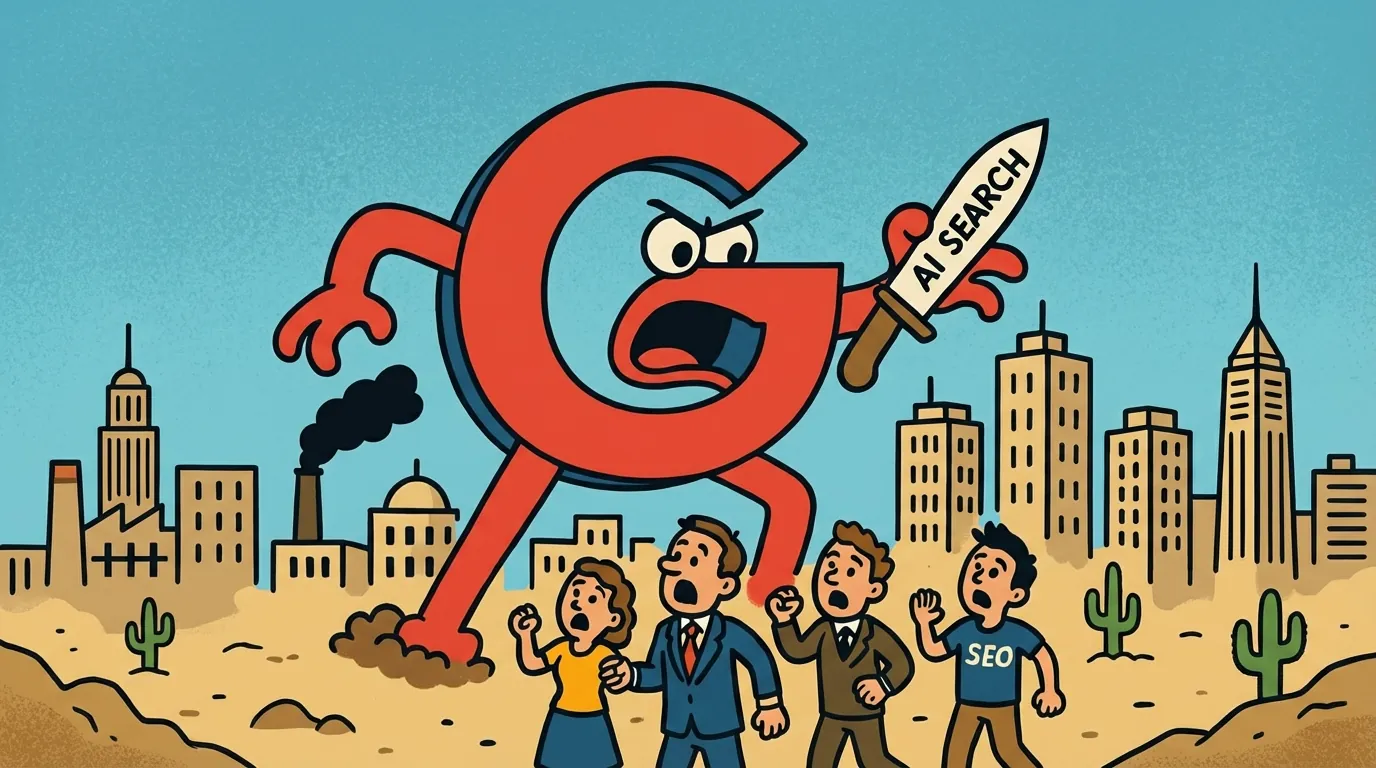
Google Search is no longer just a list of links. Google AI Overviews now appear at the top of results, powered by Google’s Gemini model. And in early 2025, Google launched something even bigger: AI Mode. This is a full conversational search experience that browses the web on your behalf. This is a fundamental shift in how people find information online. Traditional SEO tactics like keyword stuffing and basic backlink building are losing their grip fast, because Google now prioritizes context, user intent, and genuine authority above all else.
- Google AI Overviews now appear on roughly 48% of tracked queries, up from 30% a year earlier, and reach 2.5 billion people a month
- 68% of US Google searches now end without a click, up from 60% in 2024, the fastest jump in a decade
- AI Mode is live in 200+ countries and territories and passed 1 billion monthly users in its first year
- They run on different models — Gemini 3 powers AI Overviews, Gemini 3.5 Flash powers AI Mode
- Ranking and citation have come apart — only 38% of AI Overview citations also rank in Google’s top 10, down from 76% in mid-2025
- Clicks are recovering — AI Overview CTR climbed from 1.3% in December 2025 to 2.4% by February 2026, and cited pages earn more than double the clicks of uncited ones
- You can finally see your AI visibility — since August 31, 2026, every site has a Search Console report of its impressions in AI Overviews and AI Mode, though not its clicks
- SEO isn’t dead, but you need to adapt — E-E-A-T, structured content, and topical depth are what win in 2026
How Google Got Here: A Quick History
To understand where search is going, you need to understand how it got here. Google’s algorithm has evolved dramatically since 1998. The earliest version, PageRank, simply counted links to decide how important a page was. That was the birth of backlink-based SEO. Everything that followed built on that foundation and then eventually blew past it.
RankBrain: Google’s First AI Ranking System (2015)
RankBrain was the first time Google used machine learning as a ranking factor. Before it, Google matched exact keywords. RankBrain could interpret queries it had never seen before by understanding the intent behind them. Google has said for years that 15% of the queries it sees every day are ones it has never seen before. RankBrain was built to handle exactly that.
Also Read: The Complete Guide to Choosing and Registering a Domain Name
Take the example below. A search for “the reverse time movie” returns Tenet, a film whose title the query never mentions. Google resolves the phrase into a concept and then answers the concept rather than the words.
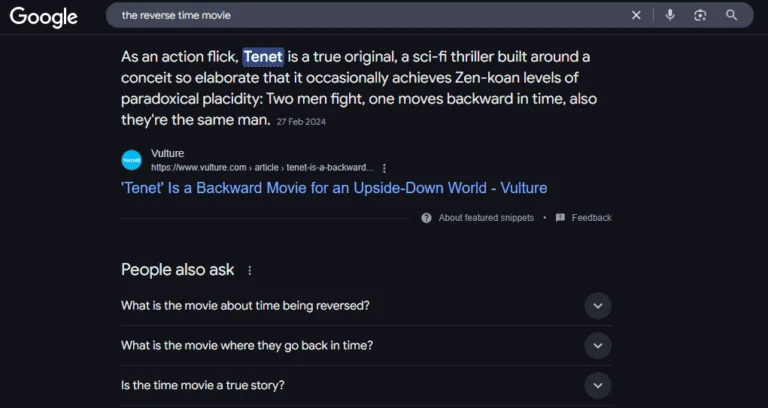
This is when keyword stuffing started losing its power. Google began rewarding content that was actually useful.
BERT: Teaching Google to Read (2019)
BERT (Bidirectional Encoder Representations from Transformers) gave Google the ability to understand context , not just individual words. It reads sentences the way humans do, considering every word in relation to the words around it.
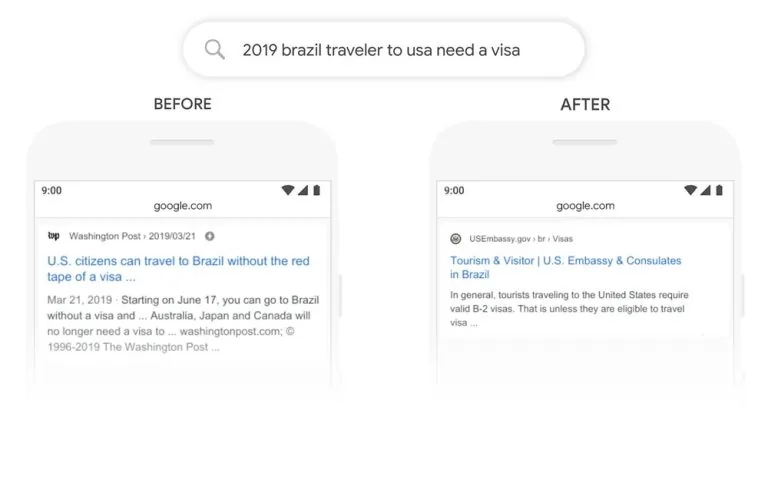
A search like “2019 brazil traveler to usa need a visa” went from keyword matching to actually understanding the question.
The perfect search engine should understand exactly what you mean and give you back exactly what you need.
MUM: 1,000x More Powerful Than BERT (2021)
Google’s MUM (Multitask Unified Model) was the biggest leap yet. It is multimodal, understanding information across text and images, with video and audio named as the next step. It was trained across 75 languages and can learn from sources that aren’t written in the language you searched in. MUM set the stage for everything that came after: AI generating answers directly in search results.
What Are Google AI Overviews?
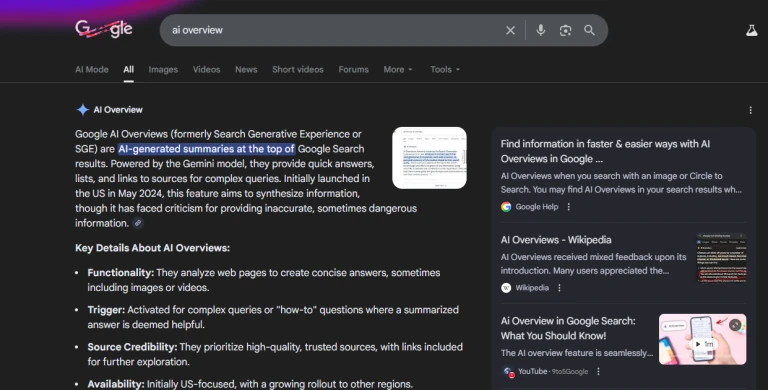
Google AI Overviews, formerly called Search Generative Experience (SGE), are AI-generated summaries that appear at the top of Google search results. Powered by Gemini, they pull and synthesize information from across the web and present it in a conversational format, complete with source links and suggested follow-up questions.
How Big Has It Got?
Huge, and still growing. BrightEdge tracking put AI Overviews on roughly 48% of tracked queries in February 2026, up from about 30% a year earlier, a 58% jump in twelve months. At Google I/O in May 2026, Sundar Pichai said AI Overviews had passed 2.5 billion monthly active users. Since January 2026, Gemini 3 has been the default model behind them globally, replacing the older router that only sent the hardest questions to the newer model.
The flip side is worth holding onto: about 52% of tracked queries still trigger no AI Overview at all. Coverage also swings hard by topic. BrightEdge’s 16-month industry breakdown, run to September 2025, had healthcare informational queries at 83.6% while ecommerce had fallen to 18.5%, as Google kept its hands off transactional searches. If you sell things, the sky is not falling in the way the headlines suggest.
Google’s own verdict, at I/O 2025, was that “AI Overviews is one of the most successful launches in Search in the past decade.” A year and 2.5 billion monthly users later, the usage numbers bear that out, whatever they have done to clicks.
What Is Google AI Mode?
In March 2025, Google introduced AI Mode, an experimental search experience built on a custom version of Gemini 2.0. It’s a full conversational search engine that uses a “query fan-out” technique, breaking your question into subtopics and issuing multiple queries simultaneously, then bringing the answers together into one response.
It has not stayed experimental for long. AI Mode is now available in over 200 countries and territories, and in July 2026 Google confirmed it had surpassed 1 billion monthly active users. It no longer runs on Gemini 2.0 either: Gemini 3.5 Flash became the global default at I/O 2026.
What Can AI Mode Actually Do?
AI Mode goes well beyond traditional search. It now has agentic capabilities: it finds open restaurant tables, event tickets and beauty and wellness appointments, then hands you a shortlist with direct links to finish the booking through partners like OpenTable, Resy, Tock, Ticketmaster, StubHub, SeatGeek, Vivid Seats, Booksy, Fresha and Vagaro. It also helps plan trips, and runs Deep Search, which issues hundreds of searches, reasons across what it finds, and assembles a fully-cited report in minutes. This is a summary of what AI Mode can do:
- Conversational follow-ups — Ask complex, multi-part questions and dig deeper with follow-ups
- Agentic booking — Find availability and compare options, then go straight to the partner to book
- Search agents — Since I/O 2026 you can create and manage your own agents in Search, starting with information agents that work in the background, around the clock, to surface what you need
- Deep Search — Full research reports built from hundreds of searches
- Generative UI — Google builds custom interfaces into the answer on the fly, including visual tools and simulations
- Visual exploration — Search by image, get shoppable visual results
- Personal Intelligence — Connect Gmail and Google Photos for tailored answers, with no subscription needed since I/O 2026
AI Mode is our most powerful AI search, with more advanced reasoning and multimodality, and the ability to go deeper through follow-up questions and helpful links to the web.
AI Mode vs AI Overviews: What’s the Difference?
AI Overviews are the quick answer, sitting on the results page you already know. AI Mode is built for the questions that need breadth, comparison and reasoning. They are converging. Since January 2026, a follow-up question on an AI Overview drops you straight into AI Mode, and the two increasingly share plumbing. But they remain separate products on separate models, and each one asks something different of your site.
| Aspect | AI Overviews | AI Mode |
|---|---|---|
| What it is | An AI-written summary pinned to the top of the normal results page | A conversational search experience with its own tab and a threaded history |
| Where you meet it | Above the blue links, unprompted, on a standard search | The AI Mode tab, or by asking a follow-up from an AI Overview |
| Model behind it | Gemini 3, the global default since January 2026 | Gemini 3.5 Flash, the global default since I/O in May 2026 |
| How it finds sources | A single pass over the index for the question as asked | Query fan-out — splits your question into sub-queries, runs them in parallel, then synthesizes the answers |
| Built for | Quick factual questions with one defensible answer | Open-ended, multi-part questions that need comparison and reasoning |
| Can it act for you? | No. It summarises and links out | Partly. Finds tables, tickets and appointments and links you to the partner to book, helps plan trips, and runs Deep Search reports |
| Scale (mid-2026) | ~48% of tracked queries; 2.5 billion monthly users | 200+ countries and territories; 1 billion+ monthly users |
| What it means for you | Being cited is what saves the click. A top-10 ranking helps but no longer guarantees a citation | Depth wins. Content that fully answers one sub-question gets pulled into the fan-out, even from deep in your site |
The practical difference is simple enough. Optimizing for AI Overviews means being the clean, quotable answer to one question; optimizing for AI Mode means having a page that survives being broken into five questions at once.
Also Read: How to Get A Custom Free Business E-mail in 2026
How AI Search Is Impacting SEO Right Now
Google AI Overviews are already changing the numbers. Seer Interactive tracked 3,119 search terms across 42 organizations and found that organic CTR on AI Overview queries fell from 1.76% to 0.61% between June 2024 and September 2025, a 61% decline. Zero-click behavior followed: SparkToro and Similarweb put 68% of US Google searches ending without a click in the first four months of 2026, up from 60% in 2024. That is the sharpest move in a decade of tracking this number.
The Part Most Guides Leave Out
Two findings from 2026 complicate the doom narrative, and both change what you should actually do.
First, clicks are coming back. Seer’s follow-up study of 53 brands and 2.43 billion impressions found AI Overview CTR bottomed out at 1.3% in December 2025 and recovered to 2.4% by February 2026. Cited pages pulled about 2.1% CTR against 0.9% for uncited ones. Google’s own framing in its Q2 2026 earnings call was that it is “sending billions of clicks to websites every week through AI features in Search”. Treat that as a vendor talking its book, but the independent CTR trend points the same way.
The second finding matters more: ranking and citation have come apart. Ahrefs analyzed 863,000 SERPs and 4 million AI Overview URLs and found that only 38% of cited pages also rank in the top 10, down from roughly 76% in July 2025. Around 31% of citations come from pages that don’t rank in the top 100 at all. BrightEdge, measuring differently, puts top-10 overlap even lower at about 17%. The studies disagree on the exact figure and agree on the direction: a first-page ranking is no longer the price of admission to an AI answer, and losing one no longer removes you from it.
This is how AI search is changing SEO:
- Less click-through traffic — AI answers satisfy users before they even visit your site
- Citation is the new ranking — Brands cited in AI Overviews earn 35% more organic clicks and 91% more paid clicks than those that aren’t
- Rankings no longer control citations — Most cited pages sit outside the top 10, so a page that never cracks page one can still be the source
- Authority matters more than ever — Google’s AI favors sources with strong expertise and credibility
- Long-tail and conversational queries are surging — People search in full sentences, not just keywords
- The technical bar has not moved — Google says there is no AI-specific markup and no special schema; eligibility is still being indexed and snippet-eligible, so a page Google hasn’t indexed can’t be cited at all
The uncomfortable consequence is that the metric most teams report on has stopped being the metric they control. Seer says it plainly:
Your SEO and paid teams might do everything right and gain visibility, but if they’re getting fewer clicks, you don’t want them optimizing to a metric they can no longer influence.
What Is E-E-A-T And Why Does It Matter Now?
E-E-A-T stands for Experience, Expertise, Authoritativeness, and Trustworthiness. It’s the quality framework Google uses to decide whether your content is genuinely trustworthy. There are no additional technical requirements to appear in Google AI Overviews or AI Mode, but the content Google’s AI chooses to cite is content that scores high on E-E-A-T.
E-E-A-T is especially critical for YMYL (Your Money or Your Life) topics i.e. health, finance, legal advice. Of all four pillars, trustworthiness carries the most weight. If Google’s AI can’t trust your content, it won’t cite it.
Our systems give even more weight to content that aligns with strong E-E-A-T for topics that could significantly impact the health, financial stability, or safety of people, or the welfare or well-being of society.
The Rise of Agentic Search
2026 is when search starts doing things for you, not just finding things. As covered above, AI Mode can find a table, a ticket or an appointment and take you straight to the partner to book it, and I/O 2026 added user-created Search agents that work in the background on what you have asked them to track.
The research behind this is public. In January 2026 Google researchers published SAGE (Steerable Agentic Data Generation for Deep Search with Execution Feedback). It is not a product. It is a training method: one AI writes hard multi-step research questions, a search agent tries to solve them, and the feedback loop tunes the difficulty. Agents trained on SAGE data scored up to 23% better on deep search benchmarks. The part that matters to you is what the researchers found when a “hard” question turned out to be easy. The most common shortcut, accounting for 35% of those cases, was that the facts needed sat together in one document, so the agent found them in a single hop instead of several.
The researchers found that when multiple pieces of information required to answer a question occur in the same document, it reduces the number of search steps needed.
A page that answers the whole sub-question in one place is a page the agent doesn’t need to leave.
What This Changes for Your Business
We are moving from “search” to “agents.” Instead of browsing a list of links, customers are increasingly using AI agents as a digital personal shopping assistant. For businesses, this means your product data, service listings, and structured information need to be machine-readable and not just human-readable.
- Optimize product data — Make sure Google Merchant Centre and structured data are perfect
- Be discoverable by agents — Clean, well-organized business info gets recommended
- Build trust signals — Reviews, credentials, and authoritative mentions matter more than ever
How to Future-Proof Your SEO in 2026
The core fundamentals haven’t disappeared; they have just changed shape. Four things are worth your attention right now.
Write for Depth
Google’s AI rewards depth. Covering a topic properly beats hitting a keyword target, and AI Mode especially rewards content that shows lived expertise: case studies, tutorials, and frameworks. Write in a natural tone and answer the question fully, without padding.
Optimize to Be Cited
Getting cited in AI Overviews is now as important as ranking on the first page. Here’s how to increase your chances of being cited:
- Use concise, direct answers especially in intros and conclusions
- Add FAQ sections and structured bullet points
- Use clear H2 and H3 headings that break down your topic logically. The same SEO blog structure fundamentals that win rankings are what make a page easy to quote
- Keep your schema markup honest; Google asks that structured data match the visible text on the page
Build Strong E-E-A-T Signals
To get cited by AI and trusted by Google, your site needs credibility signals:
- Real expert authors — Include bios, credentials, and LinkedIn profiles
- High-quality backlinks — Links from trusted, authoritative sites still matter
- Cite your sources — Link to credible references. It builds trust with both readers and AI
- Original data and research — Unique insights signal authority that AI can’t replicate
Keep Your Technical SEO Sharp
The same foundational SEO best practices apply to AI features as they do to Google Search overall, but the stakes are higher now. Make sure:
- Page speed is fast — Use PageSpeed Insights to audit regularly. Your hosting choice sets the ceiling on how fast the rest of it can be
- Your site is mobile-first — AI Overviews are surging on mobile
- Schema markup is in place and honest — Structured data earns rich results in ordinary Search; what it must not do is describe something the page does not show
- Content stays fresh — AI tools prioritize up-to-date information when generating answers
One new lever worth knowing about: in June 2026 Google began rolling out controls and reporting for AI features in Search Console, and as of August 31, 2026 both are live for every site. The reporting half is a Generative AI performance report that counts your impressions in AI Overviews and AI Mode by page, country, device and date. It does not show clicks or queries. The control half is a toggle that opts your site out of generative features entirely. Read it carefully before touching it. Google is explicit that sites which opt out “will not receive traffic or impressions from our generative AI features.” For almost every business, the reporting is the useful half.
Key Takeaways
- Google AI search (Overviews, AI Mode, and Gemini) is no longer experimental. It’s the new standard, on roughly 48% of tracked queries and 2.5 billion users a month.
- Organic CTR fell 61% on AI Overview queries and 68% of US searches now end without a click. CTR has been recovering since December 2025, though, and citation is worth more than ranking alone.
- Only 38% of AI Overview citations also rank in Google’s top 10, down from 76% a year ago. Ranking and citation are now separate games, and you have to play both.
- Agentic search (finding availability, comparing, handing off to book) is live now. Structured product and business data will determine who gets recommended.
- Search Console now reports your AI Overview and AI Mode impressions on their own. It is the first direct measure of AI visibility Google has given site owners, and it is impressions only.
- E-E-A-T, content depth, and topical authority are the most important signals for being cited by AI in 2026.
Frequently Asked Questions
Can I stop my content appearing in AI Overviews?
Only by limiting what Search itself can show. Google’s position is that “AI is built into Search and integral to how Search functions, which is why robots.txt directives for Googlebot is the control for site owners to manage access to how their sites are crawled for Search.” To limit what appears from your pages it points to the nosnippet, data-nosnippet, max-snippet and noindex controls. There is no switch that removes you from AI Overviews while leaving your ordinary snippets intact, so opting out costs you the featured snippet and the rich result as well. The Search Console toggle, announced in June 2026 and available to every site since August 31, is the blunt version of the same trade: opt out and you “will not receive traffic or impressions from our generative AI features”.
Does blocking Google-Extended keep me out of AI Overviews?
No, and it is the most common misconception about that control. Google-Extended governs whether your content trains future Gemini models and grounds answers in Gemini Apps and Vertex AI. Google states it plainly: “Google-Extended does not impact a site’s inclusion in Google Search nor is it used as a ranking signal in Google Search.” AI Overviews are part of Search and are fed by Googlebot, so a site blocking Google-Extended can still be summarised and cited in one.
Is there special schema or markup that gets a page cited in AI Overviews?
No, and Google is unusually direct about it: “You don’t need to create new machine readable files, AI text files, or markup to appear in these features. There’s also no special schema.org structured data that you need to add.” Eligibility is the ordinary bar: a page “must be indexed and eligible to be shown in Google Search with a snippet”, with “no additional technical requirements”. Structured data still earns its place. The job Google describes is “making sure your structured data matches the visible text on the page”.
How can I tell whether I’m being cited in AI Overviews?
Better than a year ago, but only by impressions. Since August 31, 2026 every site has a Generative AI performance report in Search Console, which counts how often your URLs appeared in AI Overviews and AI Mode and breaks that down by page, country, device and date. It reports impressions only. There are no clicks and no queries in it, so it can tell you a page is being cited but not which question triggered it or whether anyone clicked through. Clicks from AI features are still “included in the overall search traffic in Search Console”, inside the Performance report’s “Web” search type, mixed in with everything else. The practical method is to watch a page’s AI impressions in the new report against its clicks in the main one.
My rankings have not moved but traffic is down. What happened?
That is the signature pattern of this shift, and the chart above is the short version of why. Zero-click behaviour is part of it: 68% of US Google searches ended without a click in the first four months of 2026, against 60% in 2024. The rest is the decoupling described above: only 38% of pages cited in AI Overviews also rank in the top 10, down from roughly 76% a year earlier. A page can hold position three, lose the citation, and lose the traffic with it. Position has stopped being a proxy for visibility, which is the practical case for tracking citations as their own metric.
Final Thoughts
SEO is transforming, the way it has with every Google algorithm update. AI Overviews, AI Mode, and agentic search are reshaping how people find and act on information. The websites that will win aren’t the ones gaming the algorithm. They’re the ones building genuine authority, creating deep, helpful content, and structuring their data so AI can trust and cite them. Adapt now, and you’ll be the source AI points people to.
Want Your Website to Rank in the Age of AI?
Google’s AI is changing how websites get found and most businesses haven’t caught up yet. At ClubUnbrick, we help entrepreneurs and businesses build websites and content strategies that are optimized for both traditional search and AI-powered results. Don’t get left behind.
What We Offer
- SEO & AI-Ready Websites — We build sites structured to rank in Google’s AI Overviews, AI Mode, and traditional search
- Content Strategy — We create high-quality, E-E-A-T-driven content that Google’s AI trusts and cites
- Technical SEO Audit — We review your speed, schema markup, and site structure to make sure nothing is holding you back
- Ongoing SEO Support — Google’s algorithm keeps evolving. We keep your site ahead of every change
Let’s make sure your business is visible on Google and inside the AI answers people trust.